CrossFit was designed for 22-year-old athletes. If you're 50 and walked into one, you'd leave hurt. There's a reason.
It's not that CrossFit is a bad program. For the population it was designed for — competitive athletes with full recovery capacity, no accumulated joint history, and the structural baseline to absorb high-intensity, high-complexity movement — CrossFit makes sense. The same is true of Hyrox, which is built for people who want to compete in obstacle-race conditioning events. And F45, which is built around calorie burn and circuit novelty. These are real programs with real structure.
They're just built for someone else entirely.
At TSF, we don't do CrossFit-style training. This piece explains why — and what we do instead.
What CrossFit Actually Is
CrossFit's defining characteristics: high-intensity intervals, Olympic lifting under fatigue, complex gymnastic movements (kipping pull-ups, muscle-ups), maximum effort in compressed time windows, and a competitive culture that pushes against rest rather than through it.
Every one of those characteristics is a problem for adults over 40 with bodies that have history.
High-intensity intervals applied to adults with cardiovascular or orthopedic history raise the injury risk in ways that compound over time. Olympic lifting under fatigue — cleans, snatches, jerks — requires the kind of neuromuscular precision that deteriorates under fatigue, and for adults with shoulder or lower back history, the fatigue component turns a technically demanding lift into a structural liability. Kipping pull-ups shift load off the lats and onto the shoulder joint through momentum. Muscle-ups place the shoulder at a mechanical disadvantage that the average 52-year-old banker hasn't prepared for.
None of this is the program's fault. CrossFit was built for a specific body. The error isn't the program — it's applying it to a population it was never designed to serve.
The Same Problem in Different Packaging
Hyrox is built for competitors. The events — ski erg, sled push, burpee broad jumps — are designed to stress multiple systems simultaneously under time pressure. That's appropriate for athletes training for that specific sport. For an adult who needs their knees functional on the weekends and their lower back cooperating at their desk on Monday, it's an unnecessary risk with no corresponding return.
F45 is built around group energy and calorie-burn. The format — rotating stations, minimal rest, maximum novelty — is optimized for keeping people moving and entertained. It's effective at what it's designed for: burning calories in a group setting. What it's not designed for is building and maintaining the muscle mass that actually dictates metabolic rate as you age, or maintaining the joint integrity required to train for decades rather than seasons.
The pattern across all of these formats is the same: they're optimized for a metric — competition performance, calorie burn, athletic intensity — that isn't the right metric for adults with long training horizons, joint history, and bodies that need to function well outside the gym.
What TSF Does Instead
The methodology at TSF is built on a different framework entirely: maximum muscular stimulation, minimum joint cost.
Every exercise we use passes a risk-vs-benefit test for the specific body in front of us. The question isn't whether an exercise is good in the abstract — it's whether the training return to the target muscle justifies the joint cost for this person at this stage. For many adults over 40, standard gym staples — barbell back squats loaded to maximum, behind-the-neck press, explosive Olympic movements — fail that test. Not because the exercise is wrong, but because the cost isn't worth it for a body that needs to be functional for another 30 years.
This means every rep gets watched. Not recorded on a screen. Not checked at the end of a set. Watched, in real time, by a coach who can see what the body is actually doing — when the knee tracks wrong, when load drifts off the target muscle, when a range of motion shortens in a way the person doing it can't feel. For bodies with history, that level of attention isn't a luxury. It's what separates training that builds from training that quietly costs.
And three hours a week of that kind of training — precise, supervised, built for recovery — outperforms five hours of unsupervised high-intensity work every time. Because the adaptation happens in the gap between sessions, not during them. Compress the gap with volume the body can't absorb, and progress stalls or reverses.
The Format That Makes This Possible
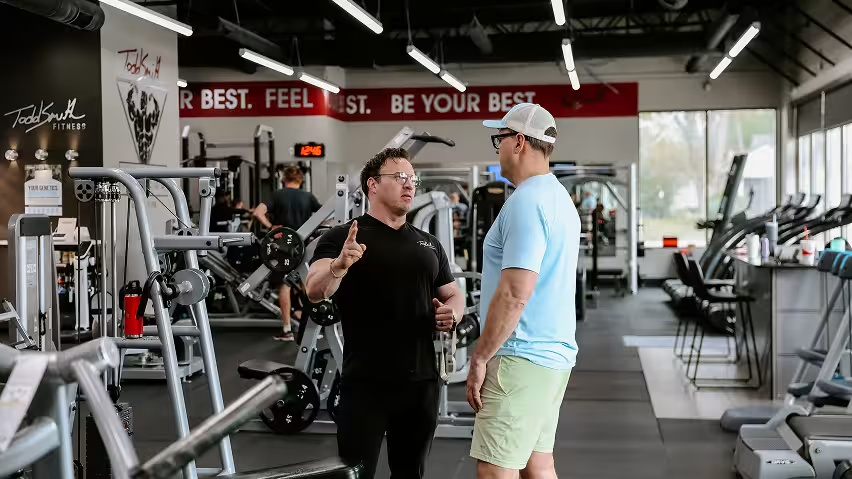
The micro-group format at TSF caps at four people per coach. That ratio exists because it's the maximum that allows genuine supervision. Above four, the coach becomes a manager of traffic rather than a watcher of movement. Below four — often three, sometimes two — the coach can see every rep, catch every deviation, and calibrate every session to what that specific body needs that day.
CrossFit classes average 10–15 people per coach. F45 doesn't have coaches in the supervision sense — it has instructors moving through stations. Hyrox prep happens in open-gym settings with trainers who may or may not see your sled form.
None of those formats can do what we do. Not because the people in them don't care — but because the structure doesn't allow it. Supervision at scale isn't supervision. It's presence.
Who This Is For
TSF is not for 25-year-olds who want to compete. It's not for people who need group energy to stay motivated, or who measure a good session by how wrecked they feel afterward.
It's for adults in their 40s, 50s, and 60s — and sometimes beyond — who want to be measurably stronger at 65 than they are at 48. Who have bodies with history and long horizons ahead. Who want training that's built for the actual population they're in, coached by someone who has been watching adult bodies respond to real training for 42 years.
That's a different thing than CrossFit. It's supposed to be.
If you're in Omaha and you're done with programs that weren't built for your body, talk to a coach. The discovery call is free. It starts with where you actually are — not where the program assumes you are.