Most fitness culture will tell you you need to be at the gym five days a week. We don't.
Three hours. That's the dose. It's what Todd Smith Fitness has been prescribing to adults in Omaha for 40 years. Not five hours. Not six days. Three hours a week, built correctly, executed consistently. That's the methodology.
If that sounds like too little, you've been listening to the wrong people.
What Three Hours a Week Actually Means
Three hours isn't a number we chose to make things feel manageable. It's the dose — the minimum effective dose for meaningful strength development in adults 40+, calibrated over four decades of watching real bodies respond to real training.
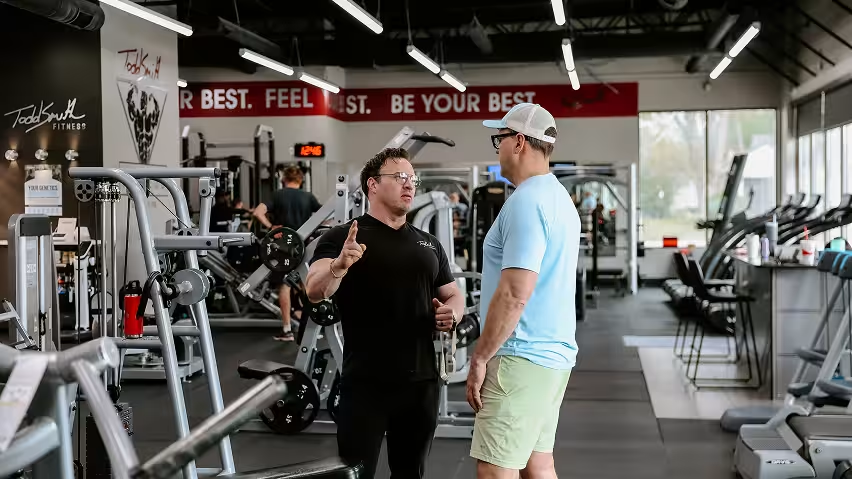
At TSF, those three hours look like this: two to three coached sessions, each roughly 60 minutes. Every rep watched. Every session built around your specific body and where it is that week. No filler. No fluff. No time wasted on exercises that don't earn their spot in the program.
Three hours done this way is not three hours at a big-box gym. At a big-box gym, three hours might mean 40 minutes of actual work and the rest wandering between machines. Three hours at TSF means three hours of training — constant supervision and calibrated programming, with a coach next to you for every second of it.
The dose works because the quality is controlled. When every rep is executed correctly, you don't need volume to compensate for inefficiency.
The Recovery Math Most Fitness Culture Ignores
Here's what the five-days-a-week crowd doesn't account for: adaptation happens during recovery, not during training. Training is the stimulus. Recovery is where strength gets built.
For adults 40+, recovery takes longer than it did at 25. The hormonal environment is different. Connective tissue needs more time. The nervous system requires more between sessions. That's not a limitation — it's physiology. And a program that ignores it isn't a harder program. It's a program that slowly breaks down the person following it.
Three hours a week, spaced correctly, gives the body what it needs: enough stimulus to force adaptation, enough recovery to let it happen. Go beyond that — without also recovering beyond that — and you're not training harder. You're training in the red. You're not building; you're breaking.
The adults who've trained at TSF for 20, 30 years aren't at the gym six days a week. They're training three hours a week. They're still here, and still getting stronger, because three hours didn't wear them out. Three hours built something that lasted.
Why More Isn't Better for Bodies With History
Most fitness programs are built around volume. The assumption is that more is better — more sets, more days, more intensity. That logic works for 22-year-olds with no accumulated wear, no existing joint load, and 10 hours of recovery per night.
That's not who TSF trains.
TSF trains adults with bodies that have lived a while. A back that's had some bad years. A shoulder that's been on the watch list. Knees that report in going up stairs. For these bodies — which is most adult bodies after 40 — volume isn't the variable that moves the needle. Quality is.
The muscle-first methodology is built on that premise: maximum muscular stimulation from each session, with minimum joint cost. Not maximum reps. Not maximum hours. Maximum stimulus from the work you actually put in, then enough space for the body to respond to it.
Three hours done with full attention — every rep coached, every exercise selected for high benefit and low risk — will do more for your body than six unsupervised hours of poorly programmed volume. Every time. That's not a claim. That's 40 years of watching what happens to real people in real bodies.
What Those Three Hours Are Not
Worth stating clearly: your TSF sessions are not cardio. Cardio at TSF is a separate prescription — specific heart-rate zones, specific duration, built to strengthen the cardiovascular system. It runs alongside the strength work, not inside it.
You're also not doing circuits. Not HIIT. Not anything that splits the training signal and dilutes the strength stimulus. Three hours of coached strength training, that's it — then cardio and recovery do their work separately.
This is the methodology Todd has refined across 40 years of one-on-one coaching. Not a shortcut. Not a workaround. The actual answer to how much training adults need to build real, lasting strength.
The juice is worth the squeeze. Three hours a week, done right, is enough to build the body you want to be living in at 60, 70, and beyond.
The 40-Year Track Record
Todd arrived at three hours the same way he arrived at everything in the methodology: by watching. 100,000 hours of working with adults one-on-one, observing what built strength, what broke people down, and what produced results that lasted across decades — not just weeks.
The members who've been at TSF for 20 or 30 years aren't professional athletes. They're not 28 years old. They're adults with bodies that have lived a while, who trained three hours a week for a long time, and are now living in the bodies that built. Strong. Mobile. Capable of the things they want to be capable of.
Three hours wasn't a guess. It was the dose that survived 40 years of contact with real people.
If you're ready to stop overthinking the schedule and start training with a methodology that's been working for adults since 1986, see how TSF membership works — or talk to a coach first if you want to understand whether it's the right fit for your body. If you're wondering why we cap our groups at four people, here's the reason