We have access to more fitness information than ever before. Between social media, podcasts, apps, YouTube, and now AI, anyone can find a workout or nutrition plan in seconds.
But having more information hasn't made people more confident. In many cases, it has done the opposite.
One expert says you need to train six days a week. Another says three. One person says every set must go to failure, while someone else warns that you're doing too much. Before long, you're questioning every exercise, every meal, and every decision.
The problem usually isn't a lack of information. It's a lack of context and application.
Every day at Todd Smith Fitness, people walk through our doors with different goals, training histories, injuries, schedules, and stress levels. They may be doing the same general workout, but that doesn't mean they should perform every exercise in exactly the same way.
That is where coaching begins. And it's why, in the era of unlimited fitness content, real personal training still matters more than an app or an AI plan.
The Why
A workout should have a reason behind it.
Why is this exercise appropriate for you? Why are we using this range of motion? Why are we increasing the weight — or holding it back? Why does your program look different from someone else's?
At TSF, we don't choose exercises simply because they're popular or have traditionally been considered mandatory. Every exercise needs a purpose. This is what we call risk vs benefit exercise selection — the framework we've built over 40 years to choose exercises that produce the intended stimulus with the least joint cost. It should fit the client's goals, physical capabilities, training history, and current needs.
Without that context, people often assume harder is always better, soreness equals progress, and every popular exercise belongs in their program.
Making someone tired is easy. Creating the appropriate stimulus and getting the intended muscles to do the work requires much more judgment.
The How
Knowing which exercise to perform is only the beginning.
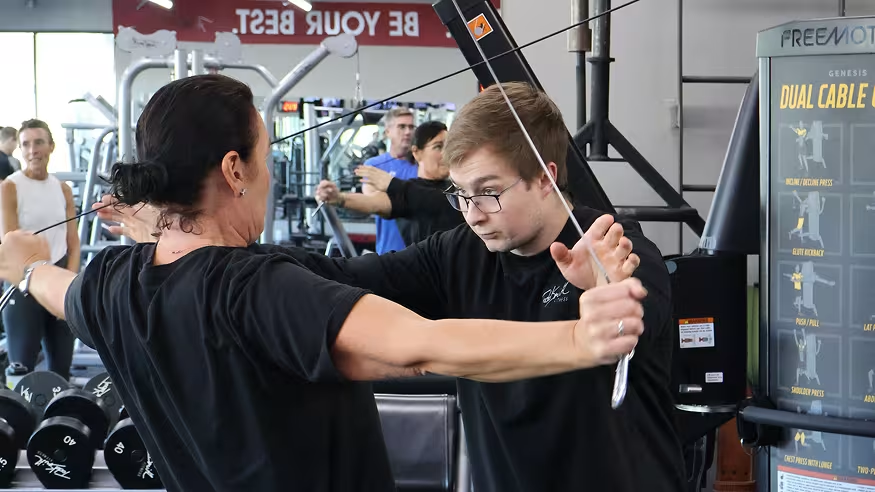
Two people can perform the same exercise and get completely different results. The details matter: setup, stability, range of motion, tempo, effort, and the ability to keep the intended muscle working.
An exercise can look correct from across the room while the person is using momentum, shifting tension into an already-dominant muscle, or compensating around a limitation.
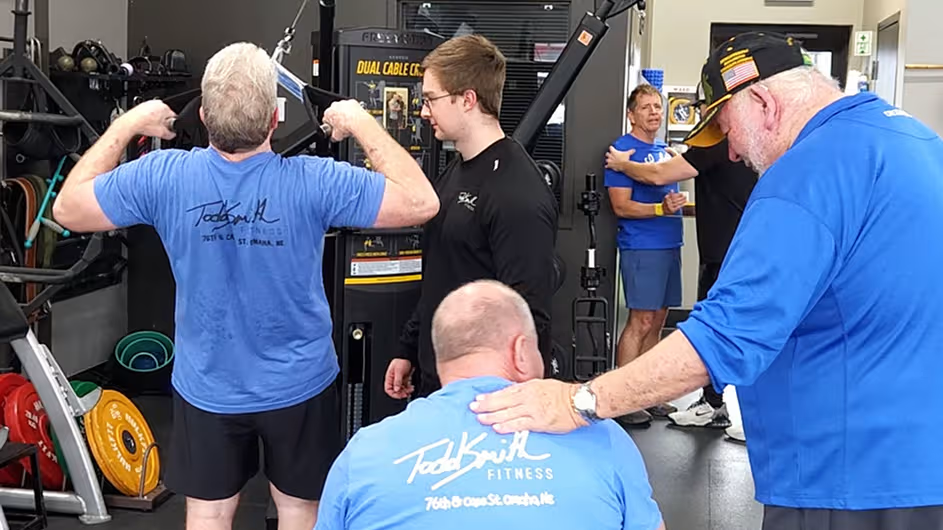
Our trainers aren't simply counting repetitions. We're watching how those repetitions are performed. This is what we call constant supervision personal training — every rep watched, every session calibrated. It's the difference between training and just exercising. We may adjust your setup, change the range of motion, slow down the movement, add support, or substitute the exercise entirely.
Sometimes a small correction completely changes what someone feels and what the exercise accomplishes.
That type of problem-solving comes from experience. Todd's training system has been developed and refined over more than 40 years. It gives our trainers a foundation for making decisions while still allowing us to coach the individual standing in front of us.
The What (And Why AI Can't Do This)
What should you do today?
The answer may change based on your experience, injury history, sleep, stress, recovery, schedule, and how your body responds during the workout.
A program is a starting point, but real coaching requires observation and adjustment.
AI can provide exercises, rep ranges, and general recommendations. Those tools can be useful. But an AI-generated program cannot watch you move, recognize that the wrong muscles are taking over, or notice that something doesn't look the way it normally does.
It can give you information. It cannot apply that information to what is happening in front of it at that moment.
That's the difference between an AI workout plan and a coach. Information vs application. It's also why, when people ask us can AI replace a personal trainer, the honest answer is: not for the work that actually changes bodies. AI can pattern-match. It can't see the tremor in the third rep that means the shoulder is compensating. It can't feel when the working muscle isn't the intended muscle. That distinction is where results live.
Removing Decision Fatigue
One of the most valuable things professionals can provide is certainty in a world filled with conflicting information.
At Todd Smith Fitness, clients don't have to walk into the gym and decide which workout to follow, which exercises to choose, how hard to push, or whether they should change their entire routine because of something they saw online.
You come in, warm up, and meet with your trainer. Within our micro-group personal training in Omaha — never more than four clients per trainer — we guide the process, watch your execution, and make adjustments when necessary.
You don't need to spend your day comparing programs or trying to become your own trainer.
Your responsibility is to show up, communicate with us, and give us your best effort. Our responsibility is to provide the plan, explain the purpose, watch the execution, and make the necessary adjustments.
Why You Need a Real Trainer (Not Just a Feed)
Information can tell you what an exercise is.
Experience determines why, how, and when it should be used.
If you're tired of choosing between conflicting programs — or between five different AI apps that all give slightly different answers — see how TSF trains adults 40+ in Omaha. Three hours a week. Every rep coached. 40 years of methodology behind it.
Information is cheap. Application is everything.