When you've coached adults one-on-one for 41 years, the lessons don't come from textbooks. They come from watching what happens — across hundreds of real people, across decades of sessions, across the gap between what fitness culture says should work and what actually does.
Some of these lessons showed up early. Some took 20 years to see clearly. All of them are in the methodology now.
Consistency Wins Every Time. Every Time.
The most physically capable members at TSF are not the ones who trained hardest in any given month. They're the ones who showed up for 10 years.
That pattern doesn't have exceptions. A member who trains three hours a week for a decade will outperform a member who trains six days a week for a year — every time — because strength compounds. Each session builds on the last. Each year adds to the one before. The body you're building in year three is being built on the foundation of year one, and that foundation only exists if you didn't burn it down trying to do too much too fast.
Most fitness culture is designed around the short term. A six-week program. A transformation challenge. A dramatic result in a defined window. That framing produces urgency, and urgency produces overtraining, and overtraining produces the injury or burnout that ends the streak.
Forty-one years of watching what happens taught a simple lesson: the people who train for a long time win. Design the program to protect that.
The Program Matters Less Than the Execution
Two people can follow the same program and get completely different results. The variable isn't the program — it's the quality of every rep across every set across every session.
A perfectly designed program executed with poor form, inconsistent load, and no real-time correction will underperform a simpler program executed precisely, watched constantly, and adjusted in real time. The execution is the training. The program is the plan for it.
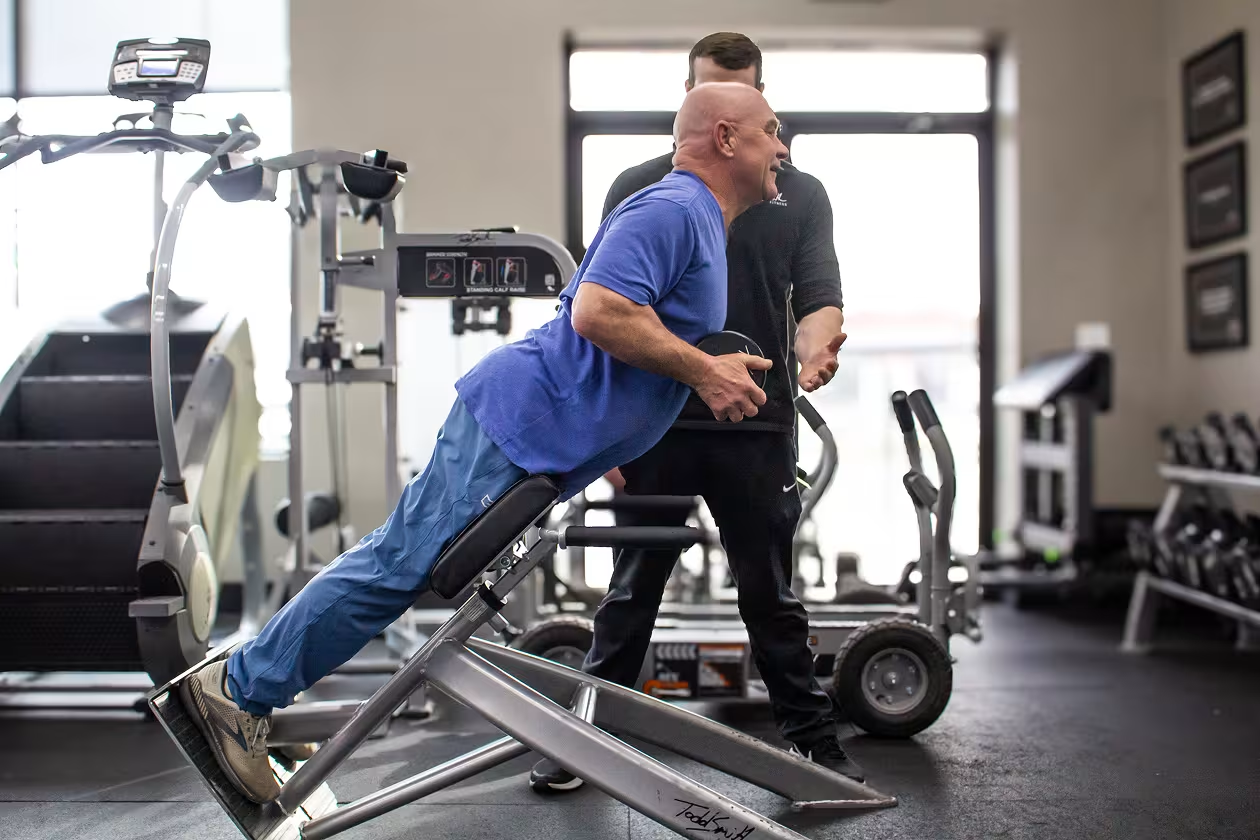
This is why constant supervision matters more than any single programming decision. A coach who watches every rep can calibrate in real time — loading the right muscles, catching compensations before they compound, adjusting when something's off. A program left to run itself can't do any of those things.
The best program is the one that gets executed well. Execution is the variable worth optimizing.
Adults Don't Need to Train Like Athletes
Most fitness programs are derived from athletic training. The progressions, the periodization models, the intensity prescriptions — they were built for people whose primary job is to perform physically, who have time to recover, whose bodies are managed like equipment.
That's not the population at TSF.
TSF trains adults with demanding professional lives, family responsibilities, accumulated joint history, and recovery capacity that isn't what it was at 28. What works for a 24-year-old with 10 hours of sleep and a full athletic support staff is not what works for a 54-year-old who needs to be sharp at work on Wednesday.
The lesson: building muscle and maintaining it across decades requires a program calibrated for that life, not borrowed from one that looks nothing like it. Muscle builds at any age — the approach just has to match the person actually in the room.
Recovery Is the Work
The stimulus happens during training. The adaptation — the actual getting stronger — happens during recovery.
This took a while to become obvious because fitness culture doesn't frame it that way. Rest feels passive. Lifting feels productive. So people add more training and reduce recovery, and then wonder why progress stalls or reverses.
The gap between sessions is when the body rebuilds the tissue that training broke down, strengthening it to handle more next time. Interrupt that gap — by training again before it's complete, by not sleeping enough, by running a caloric deficit too aggressive to support repair — and the adaptation doesn't happen. You trained. The body didn't get to respond.
Spaced sessions, adequate protein, real sleep: these aren't lifestyle add-ons to the training. They are the mechanism. The program that accounts for recovery will outperform the program that doesn't, every time, across every decade of watching it happen.
Most People Have the Wrong Goal
The most common goal adults bring to TSF is weight loss. Lose 20 pounds. Get back to where I was. Fit back into something.
The lesson from 41 years: weight loss as a primary training goal produces the wrong program. It pushes people toward aggressive caloric restriction and high-volume cardio — the exact combination that strips muscle alongside fat, slows metabolism, and sets up the rebound cycle people have usually already been through once or twice.
The goal that produces lasting results is building muscle. When muscle goes up, metabolism improves, body composition shifts, and the weight question resolves on its own — without the dramatic restriction that makes the program unsustainable. The path to looking and feeling better long-term runs through strength, not the scale.
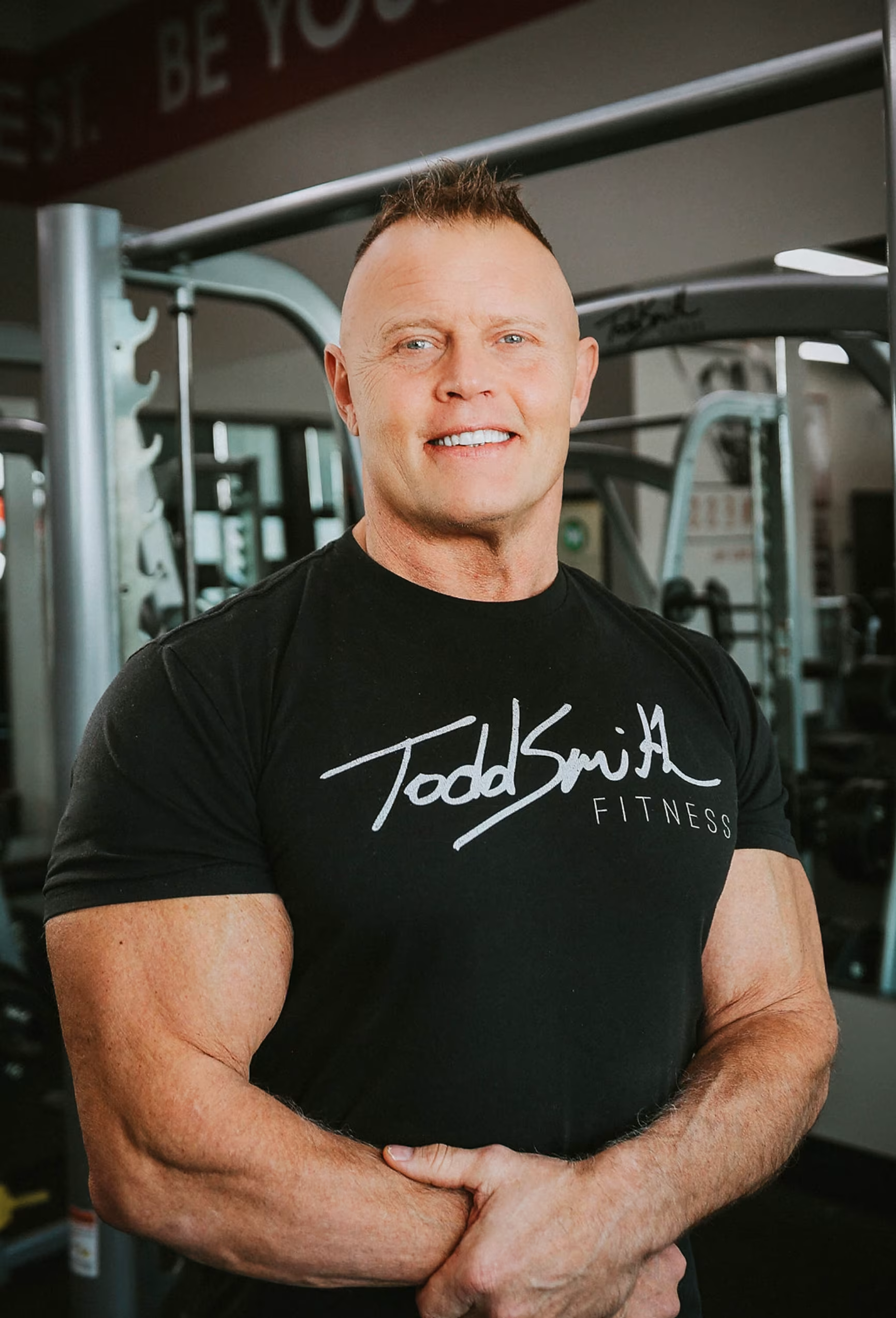
This reframe is one of the things Todd has spent four decades explaining. It takes a few conversations to land for most people. But the members who internalize it — and train accordingly — are the ones who are still here 15 years later, in measurably better shape than when they started.
Individualization Isn't a Feature. It's the Foundation.
No two bodies are the same. No two histories are the same. No two schedules, hormonal profiles, injury backgrounds, or psychological relationships with training are the same.
A program that ignores this isn't just sub-optimal — it's a mismatch from the start. The 52-year-old former runner with chronic hip tightness and a demanding travel schedule needs a different program than the 48-year-old who's never trained before, has healthy joints, and can be in the gym four days a week. Handing them the same program and calling it personal training isn't coaching.
The methodology built at TSF is consistent — muscle-first, recovery-rich, risk vs. benefit in every exercise selection. What adapts is everything else: the exercises, the load, the spacing, the pace of progression. The methodology stays the same. The application to any given person is always specific to them.
That specificity is what produces the results that last.
These lessons didn't come from a certification. They came from 41 years of being in the room. If you want to train with a methodology built on them, talk to a coach — the discovery call is free, and it starts with understanding your specific situation before anything else is recommended.